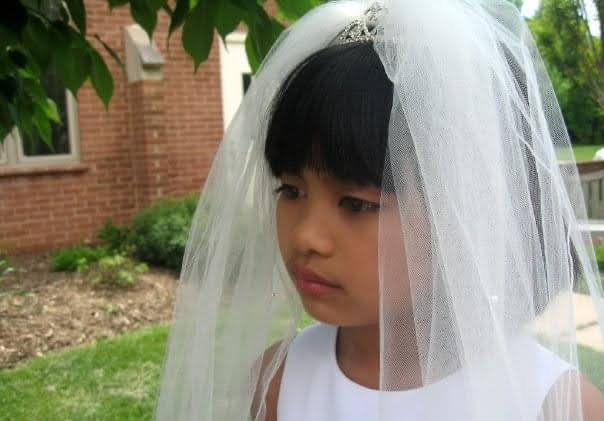
“So does that mean we get to drink wine at church?”
No, little me, Communion does not mean you get to drink wine and eat crackers during church.
When I was nine years old, I had my First Holy Communion. My classmates and I learned about this religious milestone during an aptly named period called “Religion Class”–it didn’t have the formal name of “theology,” it was always referred to as “Religion Class.” This was true, as students and teachers alike used the phrase–even our principal. It was a phenomenon that caused me to not know what “theology” meant until I was in middle school.
Now sounds like an appropriate time to disclose that I attended a private K–8 Catholic school as a child. The school was a small, old, more-pink-than-red brick building attached to a slightly larger structure holding the church. The boring, washed-out bricks gave the church a very unassuming look to it; it was worn and weathered to hell, and it seemed like the wind and rain took away any sort of life or color to be found on the outside. It was so plain that it was almost sacrilege to have what was basically a non-existent exterior in comparison to the beautiful interior and chapel. Dark wooden paneling covered the walls, the ceiling high and open, perfectly placed lights illuminating the room, and colorful glass windows depicting biblical scenes on every side. Above the decorated altar was a wooden artwork of Jesus Christ, his figure shining brightly in the center of the room, arms stretching out towards his followers, welcoming all who enter.
I remember spending hours of my life as a child just looking up at the gigantic Jesus up on the wall during mass, studying the golden pieces twinkling in the halo above his head. That big, wooden Jesus, looming over his congregation, surveying all who perch between the wooden pews, staring blankly back at those who met his eye. There wasn’t anything in the church that I didn’t focus on during in-school mass—not even the dust gathered atop doorways, the floor vents that shook to life, or the torn and tattered carpet near the intact emergency exit doors.
Going to mass, being at a Catholic school, or going to mass at my Catholic school, didn’t do much to reinforce my parents’ desire to make me into a pious young lass. Church services were sacred and holy, an important ritual in the business of Christians, using this time to pray for whatever one needs. For me, it was just a traditional way of connecting to God, a ritual in the lives of people like me. I was taught that I could pray anywhere—and it was true. My class would pray in our classroom, we’d pray in the lunchroom, and sometimes even in the hallway. However, despite my conception of prayer being God’s 24/7 hotline, I was under the impression that praying in church was more of a direct line to Him. Speed dial, if you will. Even with such a loose understanding of religion, it never clicked with me the same way it did for others; those who truly felt the power of God within them, always praising Him for the blessings He provides. The faintest glimmer of religious fervor within me was when I almost cried during a mass where we learned why Jesus was crucified.
However, a genuine interest within me was sparked when I had to prepare for my First Holy Communion, proper noun and all. This was an interesting development as a kid, since I had always seen my teachers and family drink from the shiny gold chalice and eat the elusive white wafer at each mass. Why was this act so secret and so sacred, and how could I join in? While all my interests were for much less spiritually profound reasons, I was still very eager to join the masses of Catholics eating and drinking their crackers and wine in church. I needed to be in on this, and I wanted to know how I could get it.
Eventually, we learned about it in our beloved religion class.
To put it simply, Holy Communion is just one of the first steps to becoming fully devoted to God. Receiving Communion was symbolic of becoming one with Jesus—something simple I could understand as an eight-year-old. My teacher, Mrs. Galbreath, told us that this was a huge moment for us as children of God, but I didn’t fully understand the greater significance of this happening. When she asked if we had any questions, I forgot to say that I didn’t know what any of this actually meant. Instead, I had my priorities in order: I shot my hand up and asked, “So does this mean we get to drink wine at church?” I felt a little embarrassed when my classmates giggled at the question, thinking it was a witty quip I came up with, but it was a very serious inquiry. Mrs. Galbreath chuckled at the question, then realized she had to be professional about such matters as she straightened her face and explained that it was simply grape juice in the sacred chalices. “Does everyone drink from the cup, too?” another classmate asked. Looks like my question didn’t inspire others to feel the weight of utter holiness that was to come upon us. To my classmates’ and my own dismay, finding out that the whole congregation shared the same cup was met with disgust, as “ewwwws” filled the room. I was disappointed by my teacher’s answer, but then we finally started talking about what receiving Communion meant.
It all became a little weird and unsettling when I learned that the wafer is supposed to represent Jesus’s body, and the wine is supposed to represent his blood. We were taught that Jesus broke bread with his disciples and gave them wine, so this revelation was all the more shocking. I remember thinking about how odd it was that we were symbolically cannibalizing Jesus, even though I knew it wasn’t really his actual flesh and blood. To think, we already sentenced Jesus to death, and now we’re eating him? That idea lingered in my mind for the longest time, bewildering me each time I ate a peanut butter and jelly sandwich, or had a grape-flavored juicebox. I wondered if Jesus would share his PB and J with me, or give me his juicebox at lunch, or if I would do the same for him. The answer was blurry—any nice kid would want to share, but not every (or any) nice kid is nice enough to offer their own flesh and blood. These thoughts came to me during rehearsals for the big day, and I wondered if anyone else felt this same anxiety around the concept of Communion.
The rehearsals for my First Holy Communion felt largely unnecessary, as my class only needed to know when to sit down and stand up. Looking back, it was mostly a rehearsal for the speakers, as they needed to practice reading biblical passages, scripture, or just congratulatory remarks to us children and our families. During these hours, I stared out into space or stared at all the wonderfully boring sights within the church to pass time: the mid-morning sun creeping along the carpeted floor as rehearsal droned on, the cars noisily passing by, the cobwebs resting in high corners. Twenty children, including myself, fidgeting in their places on the pews, equally as bored and restless as I. There was a steady stream of giggles, whispers, and a few quiet snores as the hour and a half crawled by, little bodies innocently waiting to be set free. We rejoiced when the teacher called it a day; we were rushing out the door, weaving through the quiet hallways, and pouring into our classroom in an excited buzz—freedom!
Soon enough, the day of my Communion arrived. It was a picturesque day in the middle of May: the sun’s rays beamed through lively green trees; the sky washed blue; licks of rich green grass stretching upwards. It was simply what one would describe as a perfect day. But for me, it all went to hell right as it started.
I was exhausted of any excitement within the days building up to this important event. My mother bought me this all-white church dress just for the occasion; a pure, angelic piece of clothing that would soon be tainted by the habits of a young child. The tulle on the skirt was scratchy and felt too fragile for someone as young as me to be trusted to wear, and the zipper in the back scratched against my neck as I moved. I was given white stockings and white mary-janes to don, complete with a little white veil decorated with pearls to enhance my image of purity and holiness. It seemed like I was the image of virtue and chasteness as my mother gushed about how beautiful I was, decked out in a stark white from head to toe.
While a very nice thought, the compliments did not persuade me to love this process as much as she did. As if being in uncomfortable clothing wasn’t enough, my mother insisted on fussing with my hair for forty-five minutes, blow-drying and styling it in the same way she did her own. I squirmed about as my hair was pulled and puffed, complaining about the heat being too much on my scalp. My mother was entirely unamused, feeling burnt by my ungrateful protests to the effort put in by her for the day. There wasn’t enough time for her to lecture me about being ungrateful, or being a “spoiled brat,” but I knew from the look on her face that those words were on her mind. In this moment of suffering, how could I have forgotten to pray for my own salvation?
By the time we set out to the church, the air was no longer crisp and refreshing. The cool morning air seemed to have transformed into a suffocating heat, the sun no longer dancing upon the ground, falling through the trees, but now razing the earth with its cruel rays. My brothers, my father, my mother and I crammed into our bulky silver minivan, a 2003 Ford Windstar; of course, on such a violently hot day, we had to pile into a car without air conditioning. Another stressor made its way onto the scene, a guaranteed obstacle: my family and I were perpetually late to everything. Knowing this, I huffed as I sat in my seat, frustrated with the timely incompetence we’ve always seemed to possess. I was worried about getting in trouble for showing up late to my First Holy Communion. My class was waiting for me—God was waiting for me—and I was going to be late.
I stared out the window in silence, the same way I would stare during our rehearsals at school. I thought about how this would all be over soon enough and I could change out of this pesky dress and veil, the shoes, the stockings, and be purified from this plague of formality. I tried to remind myself that Jesus went through worse things, much worse than what I was going through; still, I felt like my suffering could compare to his. My thoughts wandered, but my eyes stayed locked in feigned indifference on my face. There was a strange feeling that bled into my heart, something greater than the frustration from this entire ordeal. It felt like something was calling to me—was my suffering noticed by God? No, it couldn’t have been that. I paid attention to this feeling inside me and soon realized that it was simply a feeling of sadness. No tears had been shed, not even tears of anger. I think I just finally realized that I just didn’t want to be here. Not in this dress, not for this ceremony, not in this lifetime. We drove to the church in silence, letting the tension in the air speak for itself. Not a word was uttered by any of us, feeling as though any sound would trigger an explosion that none of us were ready to handle.
Despite such terrible angst, I had the mature thought of apologizing to my parents for being so bratty about this Catholic rite of passage, hoping they could forgive me for my own ignorance. After all, the day was supposedly all about me, and I should have been grateful for all that has been done to prepare me for this moment. I mean, my mom even bought me an entire fancy new outfit for this occasion, despite the financial struggles we faced. I couldn’t afford to, and my parents couldn’t afford to, make waste of this special day. It was all a gift I didn’t have the capacity to be thankful for, and I couldn’t understand why my opposition stung them so much. It must have felt like a double cross to prep their daughter so lovingly for such an important day, only to be met with profound anguish. My heart was clouded with confusion and hurt—I simply could not keep up this level of intensity without totally ignoring how much this meant to my parents. At the same time, I couldn’t have taken it seriously because of their own seriousness; I suppose that was where our misunderstanding lay. I thought it was just another Sunday service, except that I was one of the stars in this holy production.
With so many thoughts pulling me in all directions, nine-year-old me was overwhelmed when attempting to discern who was “right” in this situation. I could defy my parents’ wishes in silence, or go about it kicking and screaming. I was never really one to have disruptive tantrums, thinking I was above such shameless public flailing and screaming. Perhaps, I thought, I could stick it to my parents by being absolutely stoic about this event, and they would leave me alone about anything like this in the future—that would really show them. But then, what was I trying to show them? My young mind hadn’t gotten this far, often losing sight of my already vague objective due to the alternating emotions about the day. This blind dedication to this unknown goal was admirable, as it was the first of many moments where I stood my ground, but it did me little to no good. My thoughts engulfed me, but the sharp turn my father made while pulling into the school’s torn-up parking lot ripped me out of that void.
Upon arrival, I saw the rest of my classmates dressed up in shades of white and ivory, with the girls dressed in dainty little dresses and frills, and the boys dressed sharply in straight, pale suits. There were a few parents milling about in the lobby, eventually making their way into the church. My classmates and I really did look like a bunch of little angels flitting about. We ran throughout the hallway before the service, smiling, giggling in big flashes of white. Soon enough, families were ushered away from us children to prepare for our special entrance into the church. As I saw my family wave goodbye to me, I felt a twinge of nervousness and despair radiate through my body. How I longed to be able to run to them, repenting for my carelessness.
I moped throughout the service and waited for my moment to get it all over with. I ticked off all the boxes of what consists of mass: the opening hymn, opening remarks, the sermon, more hymns, and then the preceding remarks to the event that captured its audiences. I knew that in less than an hour, I would be free of this formality. As it approached, I was distracted from my anger when I realized how many people were there, expecting my classmates and me. I was weighed down with intense anxiety while waiting for my turn to go up. Goosebumps spread all over my arms, my heart thumping in my chest, and a feeling of being frozen chilling my mind and body. There was nothing to do but count the number of people before me, ignoring the excited buzz of the congregation as each child walked up to the front. To me, this special time in the spotlight was much more stressful than any sort of primping and preening I could ever receive.
Ignoring the parents, siblings, aunts, and uncles snapping photos on their little digital cameras, the flash too bright and the images too overexposed, my hands shook in my lap as I rehearsed my “part” over and over in my head. All I had to do was walk up there, eat the wafer, and maybe drink the grape juice, then I could run back to my seat and collect myself for the rest of the service. Of course, it was a little more complicated than that. I had to walk at a certain pace, clasp my little hands in grace during my approach, offer my palms for Him, and then say a small prayer before I ultimately become one with God. I carried out this routine a million times before, excluding the ritualistic consumption of “bread” and “wine,” so I tried to reassure myself it would be exactly the same. Unfortunately, the way that my dress scratched and clawed at my legs through the stockings only served as a reminder that this was happening, and that I wasn’t just a normal churchgoer on this day.
When I saw the boy before me rise out of his seat, I realized it would soon be time for me to walk down the aisle and consume the body and blood of Christ. I felt like my little heart would give out from how fast it was beating, or that I would pass out from how stressed this event made me. My teacher cued me to march, and it was dizzying to stand up and walk those few feet to the front of the church. My heart was in my throat, and my eyes were darting around at all the happy faces surrounding me, their unmoving smiles and the clicks of their camera overwhelming me. Tears threatened to spill from my eyes and onto my face as I rushed through the line of parents and teachers. I could only describe that moment as creepy, as all of these adults carefully and gladly watched a group of children eat and drink for a brief moment. Finally, I made it out of the treacherous space, presented my clasped hands to the pastor, and waited desperately for his line: “The body of Christ.”
I don’t think I’ve ever said “amen” so readily.
The room buzzed with excitement as the last child received Communion. I was entirely surprised by how proud some of my classmates were, grinning in their seats, lost in joy as they searched for their parents’ faces in the pews behind us. Soon enough, the service concluded, and this portion of my journey within Catholicism had been completed. This knowledge had no effect, and I still felt like the same me. There was no renewed sense of religious fervor within me, no likelihood of channeling the Holy Spirit and speaking in tongues. I felt like I was watching the ending scene of a movie, as children and their families happily strolled out of church and along to their cars, and I imagined how smoothly their day must have gone.
After filing out of the church, sliding past the joyous, cherub-like faces of teachers and clergy members stuffed into the small lobby, my last cross to bear was taking photos of this momentous occasion. Standing outside in the church’s little garden, I was positioned in front of a small tree, the camera pointing down at my face: eyes glazed over from exhaustion, mouth slack and straight. When I look at these photos, I wonder if the effort was worth all the exhaustion and upset from hours of resistance–futile resistance, if I may add.
Had I even made a point to my parents? I thought I was Joan of Arc with the resolve I had, willing to bear the consequences for what I believed in, but I hadn’t done anything in particular. Among the families who prayed together and stayed together, I felt like we were an anomaly. What did it mean to still feel so empty and unaffected by faith, when all I did and all I felt was so similar to the martyrs I learned about in class?
This feeling of emptiness or indifference did nothing but push me away from religion. My efforts to be one with the group, to be one with God, felt futile. I really wanted to be able to believe, but nothing made me feel the supposed wonder and comfort of faith. I prayed because I was told I should, and the lack of meaning that prayer had to me in its introduction was probably what caused my detachment from Catholicism and Christianity. Not only that, but I thought that mass was just so boring and stiff for us Catholics. Perhaps if my church’s congregation swayed, danced, and sang in passionate praise, I would have been more interested.
Another issue I had with faith, and maybe this was just an odd case for my family, but church and prayer didn’t bring us together. We went to church, but we never bonded over our shared faith, despite my parents emphasizing the importance of God in our lives. Would that have bettered my relationship with them? Would my prayers save my parents from hours of work, and give them time to be with me? So much of my childhood was taken over by forces I couldn’t control. Financial struggles rocked my parents’ relationship, so prayers felt like a lost cause. I couldn’t pray for my parents to stop fighting, I couldn’t pray for money to come our way.
Despite such troubles, I never felt like God abandoned my family and me. We always somehow managed to make it out of any hardship, miraculously so—perhaps someone out there must have been looking out for us. This experience with Communion didn’t cause me to condemn my Catholic roots, nor did any other following tragedies; however, I still find myself very removed from the idea of faith. Though not partaking in it, I still find it to be this wondrous, expansive thing I can’t wrap my arms around. It is both beautiful and alien to me. I would say that I’ve experienced things that would shake anyone’s faith, or alternatively, reinforce or (re)introduce faith into one’s life. I still visit church with my family on special occasions, I still accept and welcome it when people say they’ll pray for me, or tell me that I’m in their prayers. I haven’t turned to God in a long while, but I’ve made some great efforts to better understand my relationship with religion through exploring the Bible, thanks to a wonderful class I recently took. Becoming reacquainted with much of the Bible after never looking back in my pre-teen years has been eye-opening to what could have been. While that religious fervor was never reinstated into me, I have a much better appreciation of what I was meant to absorb from “Religion Class.” A biblical narrative that has really stuck with me is the story of Job. He suffers and suffers, yet he never loses faith in God. After a long silence, God answers Job’s questions and rewards him for his unwavering devotion, restoring his friends, wealth, and home. Could life have been easier if I were like Job, to find comfort in faith despite the troubles that have come my way? Could there be more joy in my life if I were to start believing in something greater than me—to not question if there wasn’t something greater than me? Possibilities aside, I still find that there are blessings in my life, ones that I sometimes don’t quite understand how I’ve gotten to receive. I suppose I’ve finally come to better understand what I’ve heard countless times after Communion: the mystery of faith.
 grossly sincere
Leave a comment